
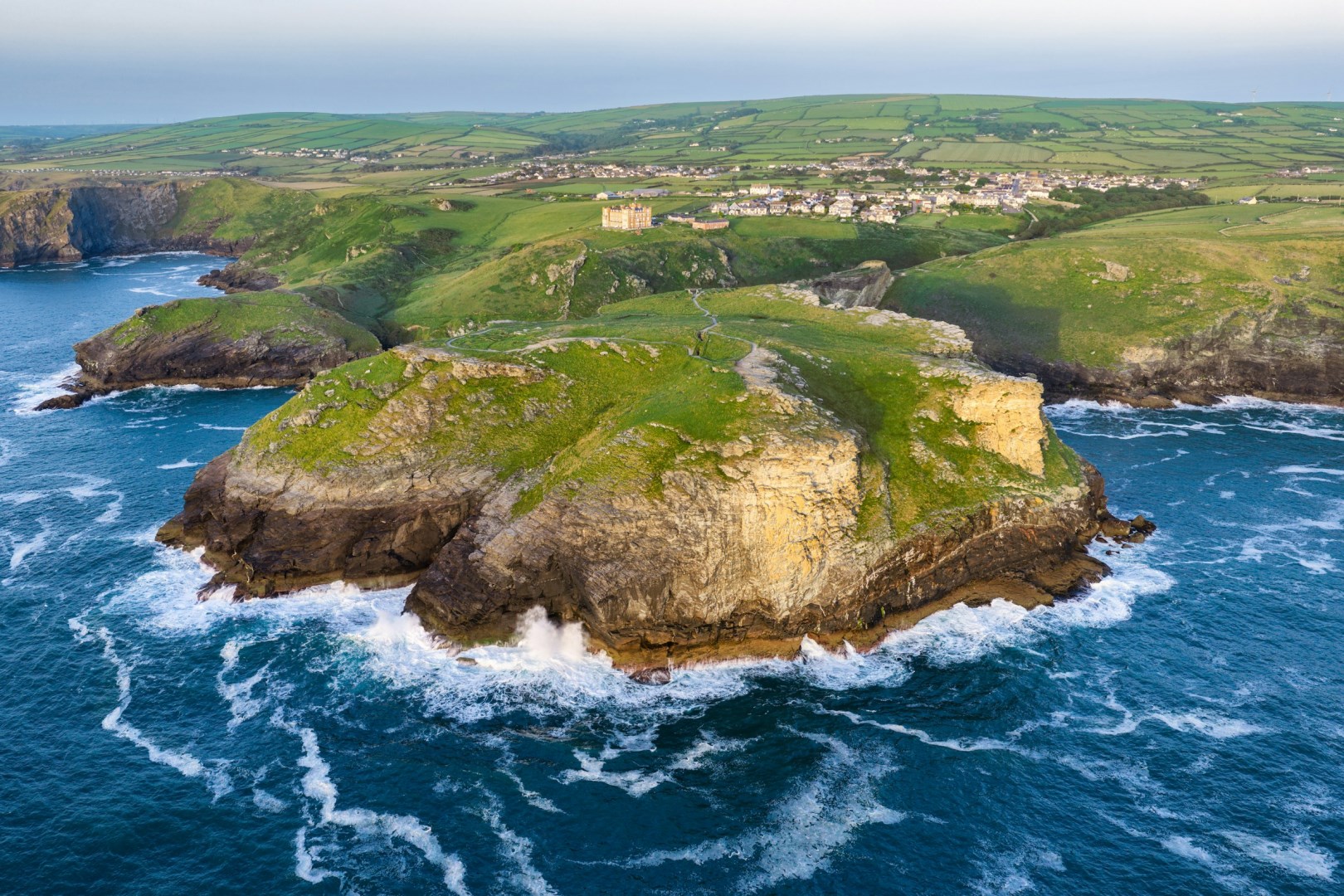

Tintagel is a village on Cornwall's north coast, set among rugged cliffs overlooking the Atlantic Ocean. The area is best known for Tintagel Castle, whose remains occupy a dramatic headland connected to the mainland by a footbridge. The village itself has a traditional Cornish character, with stone buildings, small shops, cafés, and places to stay along the main road. Tintagel's location on the South West Coast Path makes it a useful base for exploring nearby coves, cliffs, and coastal countryside, while the surrounding landscape combines exposed headlands with sheltered valleys and farmland.
Tintagel's identity is strongly connected with the legends of King Arthur, although the stories belong to medieval tradition rather than established historical evidence. Geoffrey of Monmouth's account associated Tintagel with the conception of Arthur, helping establish the headland as an important place within Arthurian literature. The castle also has a documented medieval history, while archaeological evidence indicates earlier occupation of the headland. Nearby St Materiana's Church contains medieval features and stands above the coast, adding another layer to the area's religious and architectural heritage.
Tintagel Castle occupies a narrow headland divided by a deep gorge, with cliffs dropping toward the Atlantic on several sides. The castle ruins include remains of medieval buildings, defensive walls, and terraces, while the footbridge provides access to the island section of the site. Merlin's Cave lies below the headland and can be reached from the beach at low tide. The South West Coast Path follows the cliffs around Tintagel and connects with nearby coastal sites such as Bossiney Cove and Rocky Valley, where a stream runs through a narrow wooded gorge toward the sea.
Food in Tintagel reflects Cornwall's coastal and agricultural traditions, with seafood, Cornish pasties, cream teas, and locally produced dairy products commonly available in the village. Cornish clotted cream is traditionally served with scones and jam, while local bakeries and cafés offer pasties made with beef, potato, swede, and onion. One of Tintagel's most distinctive features is the way mythology and landscape overlap: the castle headland, sea caves, cliffs, and medieval remains have all contributed to the area's enduring association with Arthurian stories. The village also contains the Old Post Office, a historic building now cared for by the National Trust.
Other Popular Destinations in England


